
Barry and Sadie Save Children from the Dangers of Learning

An original satire featuring Barry Spud and Sadie Tater. Their school programme and classroom scenes are fictional; linked articles provide related commentary.
Sadie and I have identified a serious gap in workplace safety.
Children are arriving at school curious.
Unless we intervene early, they may develop judgement, initiative and the confidence to ask why.
We have therefore launched Little Spuds, Big Compliance, our safety superhero programme for schools.
Our mission is simple: protect children from risky learning until they are old enough to be a thought leader.
Qualifications you can trust
The principal asked about our experience in childhood education.
I explained that I had delivered hundreds of inductions.
Sadie added that she had children.
“Bully and Sarcasm,” she said. “Both leadership material.”
The principal mentioned developmental learning, play and professional teaching qualifications.
I showed her my laminated certificate.
We cannot let every profession invent obstacles to our expertise.
Every child a superhero
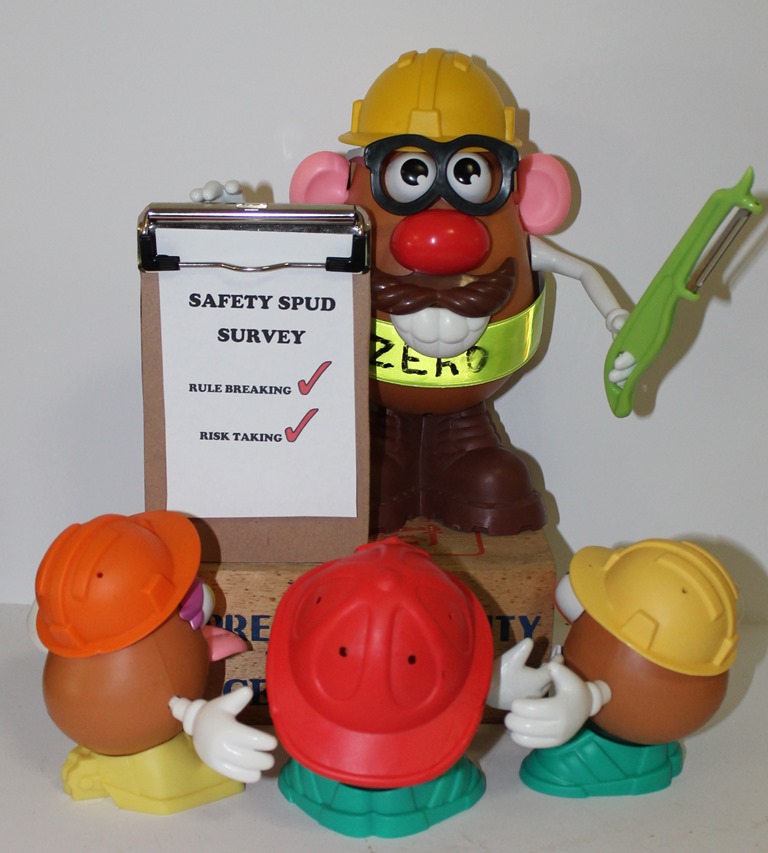
Inspired by the debate about safety superheroes, we equipped every child with hi-vis, a clipboard and the authority to identify faults in their friends.
The children initially wanted capes.
Sadie prohibited them.
Then they wanted to pretend they could fly.
We prohibited that too.
Within twenty minutes, we had created superheroes whose only permitted power was reporting.
Bully flourished immediately.
Sarcasm told a child struggling with his vest, “Excellent start, Captain Competent.”
Sadie noted his natural coaching ability.
Replace discovery with approved answers
Our first lesson addressed risk and learning.
The teacher had planned an activity in which children built bridges from cardboard, tested them and discussed what happened.
I was horrified.
“You mean some bridges might fail?”
“That’s part of the learning.”
We replaced the activity with a picture of an approved bridge.
Every child successfully identified it as a bridge.
No structural failures. One hundred per cent competency.
The teacher asked what they had discovered.
“The correct answer,” said Sadie.
A playground without uncertainty
During our inspection, we found children climbing, balancing, negotiating rules and deciding what they felt ready to try.
There was barely a document in sight.
One child was cautiously testing a low climbing frame while her teacher watched nearby.
Sadie intervened.
“Have you done this before?”
“No.”
“Then you’re not competent.”
“How do I become competent?”
“By demonstrating that you can do it.”
The child looked confused.
An excellent introduction to the workplace.
Someone asked how safe is too safe.
I explained that we would know we had gone too far when the insurer complained.
Critical thinking, carefully controlled
We encourage questions.
“Why do we need to wear these indoors?” asked a child.
“For safety.”
“What danger do they protect us from?”
“Next question.”
The teacher suggested we were confusing education with indoctrination.
I disagreed.
Indoctrination tells children what to think.
We let them select it from three options.
Measure the benefits
By lunchtime, running had stopped, the climbing frame was empty and nobody had attempted anything unfamiliar.
Our results were outstanding.
The teacher said several children now seemed anxious about ordinary play.
I recorded increased hazard awareness.
Another child refused to draw because he might make a mistake.
Sadie awarded him a sticker for stopping an unsafe activity.
We were particularly pleased with the reduction in playground disagreements.
Nobody was playing together.
The graduation ceremony
At graduation, we asked the children what they had learned.
“Wait for permission.”
“Tell on people.”
“Don’t try things.”
Sadie wiped away a proud tear.
Then a little girl asked whether looking after each other could simply be part of everyday life, without everyone becoming an inspector.
The teacher smiled.
I recognised the danger immediately.
Independent thought, reinforced by an authority figure.
We have recommended refresher training.
Our sponsor is delighted. The children have stopped asking what they can discover and started asking what they are allowed to do.
Finally, school is preparing them for work.
Barry Spud
Latest posts by Barry Spud (see all)
- Barry Spud Discovers Ethics: Unfortunately, It Applies to Him - November 7, 2026
- Kevin Returns from SPoR: Emergency Reinduction Required - November 7, 2026
- Safety Santa Is Coming to Audit - November 7, 2026
- Barry Spud Discovers the Value of Safety - November 7, 2026
- Sadie Tater Sees Red Over Pink - November 4, 2026
Ah, there’s nothing better for safety than the indoctrination of children. I consulted Eric Eggplant and he told me that ethics are not important in safety.
Eric’s absolutely right. We considered including ethics, but it encouraged children to question authority. Sadie replaced it with a colouring exercise: stay inside the lines, make everything green and never ask who drew the box