
SPOR Is Making Safety Unnecessarily Human

I have recently been exposed to the work of Dr Rob Long and the Social Psychology of Risk.
I say “exposed” because I am still assessing the consequences.
Until now, my professional practice was straightforward. Identify a hazard, assign a number, select a colour and remind someone to be careful.
Then Long arrived asking what I understood by personhood.
I have been in safety for thirty years. Nobody has ever needed a personhood permit.
Naturally, I became suspicious.
The unacceptable persistence of people
My first difficulty with SPoR is its preoccupation with persons.
Workers already occupy a disproportionate amount of my time by forgetting things, interpreting instructions and having experiences not covered by the procedure.
Long appears to regard these characteristics as fundamental to being human.
I regard them as outstanding actions.
He encourages us to consider relationships, meaning, learning and ethical practice.
I want to know whether they watched the manual-handling video.
Apparently, understanding a person involves more than checking their training record.
This could seriously affect our audit schedule.
Wicked problems should receive a formal warning
Then I encountered wicked problems: problems with competing perspectives, tangled causes and consequences that do not politely disappear when we announce a solution.
I was appalled.
My corrective-action register offers two options: OPEN and CLOSED.
There is no dropdown for “An ongoing social dilemma requiring judgement, negotiation and attention to unintended consequences”.
I asked IT to investigate. They suggested making the column wider.
Consider fatigue. Workers mention rostering, commuting, family responsibilities, production demands and whether they can afford to turn down overtime.
I prefer to describe the problem as insufficient awareness of fatigue.
That way, I can solve it with a presentation.
When someone pointed out that my compulsory after-shift fatigue session would delay everyone getting home, I recognised an emerging wicked problem.
I closed the action before it developed further.
Risk homeostasis: people adapting without permission
The discussion of risk homeostasis was equally inconvenient.
The theory proposes that people adjust their behaviour in relation to the risk they perceive and the benefits they seek. Feeling better protected may change what they are willing to do.
I had assumed people would respond to my initiatives exactly as specified in the launch presentation.
We installed a new warning system, and I immediately declared the workplace safer.
The production manager suggested increasing throughput now that we had additional protection.
Suddenly, I could see how a safety improvement might become an invitation to demand more performance.
This did not mean the warning system was useless. It meant we needed to examine what changed around it.
Unfortunately, examining what changed around it was not included in the procurement budget.
We had purchased the equipment, the launch photographs and the confidence.
Follow-up was extra.
The unconscious has not completed its induction
My greatest concern is unconscious decision making.
Apparently, habit, experience, emotions and social cues influence what people do without everything passing through a deliberate internal committee meeting.
This presents serious difficulties for my “Stop and Think” campaign.
I had imagined workers consciously reviewing all 247 induction slides before touching anything.
Instead, experienced people often recognise situations and act through familiar patterns.
I demanded to know who had authorised these patterns.
Then, while considering the question, I drove home, unlocked the house and made a cup of tea without conducting a documented task analysis.
This was different.
Mine was experience. Theirs was complacency.
I am now developing a procedure requiring workers to notify me before making an unconscious decision.
My posters have been communicating without approval
Long’s interest in language and symbols has also unsettled me.
I thought a poster meant whatever I intended it to mean.
If I displayed “Safety Is a Choice You Make”, the message was obviously that I cared.
Apparently, an injured worker might hear something rather different.
Now I must consider what people understand, what remains unspoken and what my messages imply about responsibility.
I examined the mirror in our induction room, which tells workers they are looking at the person responsible for their safety.
For the first time, I noticed that the board, the purchasing department and the production schedule were missing from the reflection.
I ordered a larger mirror.
Fragility: the system works until something happens
The discussion of fragility raised another uncomfortable possibility: excessive control can leave people poorly prepared to exercise judgement when circumstances change.
I have spent years preventing workers from making decisions without permission.
Then, when something unexpected occurs, I ask why nobody showed initiative.
Our system is exceptionally robust, provided the job follows the procedure, the equipment behaves normally, staffing is adequate and the unexpected gives us fourteen days’ notice.
Last Tuesday, the electronic permit system failed.
Everyone waited for someone authorised to authorise an alternative.
Unfortunately, his authorisation was stored in the permit system.
A fitter suggested discussing the job together and working out what was needed.
I told him we could not simply rely on human judgement.
We then waited three hours for a manager to arrive and use his.
Fallibility is acceptable in principle
Long’s writing also keeps returning to fallibility.
I have no objection to acknowledging that humans can be mistaken, provided it does not interfere with our expectation that nobody will be.
We accept fallibility at a strategic level.
At an individual level, we require an explanation.
The suggestion that learning involves uncertainty is particularly troubling. I prefer learning outcomes agreed in advance and demonstrated by participants selecting the answer I have already highlighted.
Otherwise, people might learn something I had not intended.
Some might even question the training.
Listening has affected my productivity
I decided to try listening to a worker without immediately correcting him.
He described a difficult task, competing demands and several adjustments the crew made to keep things going.
I waited for the point where I could tell him to follow the procedure.
It never arrived.
Instead, I began to understand why the procedure did not fit.
This was deeply inconvenient. Previously, the problem belonged to the worker. Now it required my involvement.
He also knew things I did not.
I have reported this as a gap in our information-management system.
The most fragile thing on site
I initially suspected that Long was making safety too complicated.
I am beginning to suspect he is drawing attention to complications I have been carefully excluding.
There is a difference between making something understandable and making it fit inside my existing form.
This morning, a young worker asked whether my resistance to SPoR might involve habit, identity, unconscious assumptions and a preference for familiar answers.
I told him not to psychoanalyse me.
He suggested we explore the question together.
I explained that I was perfectly open to learning, provided it did not require me to reconsider anything.
Then I realised the most fragile thing on site might be my expertise.
I have protected it with a laminated certificate.
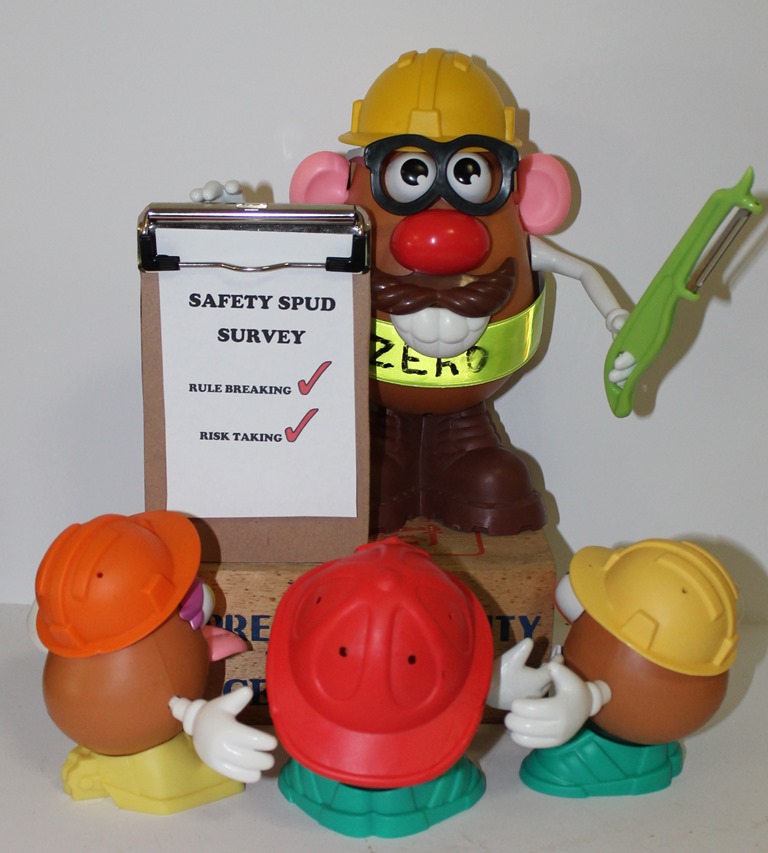
Barry Spud
Latest posts by Barry Spud (see all)
- Barry Spud Heads to Egypt: The Plant Upgrade Begins with His Departure - November 9, 2026
- Barry’s on Holiday. His Slogans Aren’t. - November 9, 2026
- Want to Meet Barry Spud? You Already Have. - November 9, 2026
- Barry Spud Discovers Ethics: Unfortunately, It Applies to Him - November 7, 2026
- Kevin Returns from SPoR: Emergency Reinduction Required - November 7, 2026
Thanks Barry, a nice roundup. Does SPoR work on paspalum?
ahh – another pest that just does what it wants where it wants, you’ll want a nice roundup (shame about the glyphosate) for that but SPoR should work if you carefully follow the directions your gut gives you