
How to Be a Safety Professional Without Being Troubled by People

Usually, these are workers, and usually their next question is whether I could move my vehicle because I’ve blocked the ambulance access.
My answer is simple: a safety professional makes uncertainty look organised.
Anyone can walk onto a site and admit they don’t fully understand what is happening. It takes a professional to arrive with a graph that proves they do.
Over the years, I have developed a reliable methodology for transforming the messy business of human life into something management can approve before lunch.
It begins with the right tools.
The Bradley Curve: putting people in their place
Before discovering the Bradley Curve, I had no idea how to measure culture.
After discovering it, I still didn’t, but I had somewhere to point.
The beauty of the curve is that it allows me to position an entire workforce along a journey from disappointing to commercially promising.
I establish their position through a rigorous process involving a questionnaire, several management interviews and finding out which result will secure the next phase of consulting.
Workers who question the process demonstrate that they have not yet reached the stage where they stop questioning the process.
This is why the curve is such a powerful diagnostic tool. Agreement validates it. Disagreement validates the need for more of it.
Last month, a crew suggested that culture might involve trust, history, relationships, power and what happens when somebody speaks up.
I showed them the curve again, this time using the laser pointer.
You cannot help people who refuse to engage with evidence.
Behavioural Based safety: observing everything except ourselves
Behavioural safety taught me to focus on what is observable.
This is extremely useful because a worker’s missing glove is observable, while the budget meeting that removed three maintenance positions is not observable from where I’m standing.
I therefore concentrate on gloves.
Our observation programme encourages workers to watch one another and report unsafe acts. Management calls this ownership. The workforce has developed several other names for it, which we have classified as resistance.
I once observed a worker taking a shortcut.
He explained that the approved route was obstructed, the job was behind schedule and his supervisor had told him to hurry.
I thanked him for providing three distractions from the behaviour I was observing.
We then had a positive safety conversation in which I explained the correct answer and he eventually repeated it.
That is engagement.
We now conduct two hundred observations a month. Nobody has established whether the conversations are helpful, but we have absolute confidence that there are two hundred of them.
Heinrich: building certainty from the bottom up
I have always admired a triangle.
It has a broad base, a clear direction and nowhere for awkward questions to sit.
Heinrich’s accident pyramid has been particularly valuable because it allows me to arrange events by size and then feel that I have explained their relationship.
In my implementation, every small incident becomes a down payment on a large one.
A paper cut is therefore a serious opportunity to demonstrate our commitment to preventing catastrophe.
Last week, someone asked whether the events we count at the bottom necessarily tell us enough about the conditions that produce a fatality.
I explained that this was precisely the sort of negative thinking that could damage the base of the pyramid.
We have since launched a campaign on stapler injuries.
Meanwhile, the maintenance manager keeps raising concerns about a deteriorating lifting arrangement.
I have asked him to submit more minor incidents so we can build an evidence base.
The risk matrix: where guesses receive a uniform
The risk matrix is the centrepiece of my professional practice.
Before using one, we merely have uncertainty.
After using one, we have a number.
Our team recently assessed an activity as “unlikely” with “major” consequences. Another team assessed the same activity as “possible” with “moderate” consequences.
Some people saw this as a problem.
I saw an opportunity for a facilitated workshop.
After forty-five minutes, we agreed on the square that allowed the job to proceed.
This is called consensus.
The real genius of the matrix is colour. A concern expressed by a worker can sound emotional and subjective. The same concern placed inside an amber rectangle becomes a management instrument.
Occasionally, a worker asks what has physically changed when a risk moves from red to green.
I explain that we have added controls.
“What controls?”
“A procedure, a briefing and a requirement to remain aware.”
“But the equipment is still broken.”
“Yes,” I say, “but now we are aware of it.”
Professional judgement: knowing when to stop listening
Of course, tools alone do not make a professional.
You also need confidence, an acronym after your name and the ability to describe disagreement as a training need.
My job is to ensure people understand that safety is everyone’s responsibility, while retaining exclusive authority to explain what safety means.
We encourage workers to bring their whole selves to work, provided the inconvenient parts remain in the car.
We value experience, except when it contradicts the procedure.
We promote critical thinking, especially when it produces the approved answer.
And we never let paperwork replace conversation. We require the conversation as well, then ask everyone to sign the paperwork confirming it happened.
Yesterday, a young worker asked whether being a safety professional might mean listening carefully, acknowledging uncertainty, understanding the work and helping people get the resources to do it well.
I was deeply concerned.
There was no curve. No triangle. No score. Nothing I could put on a dashboard.
Just a person asking for help.
Fortunately, I had a form for that.
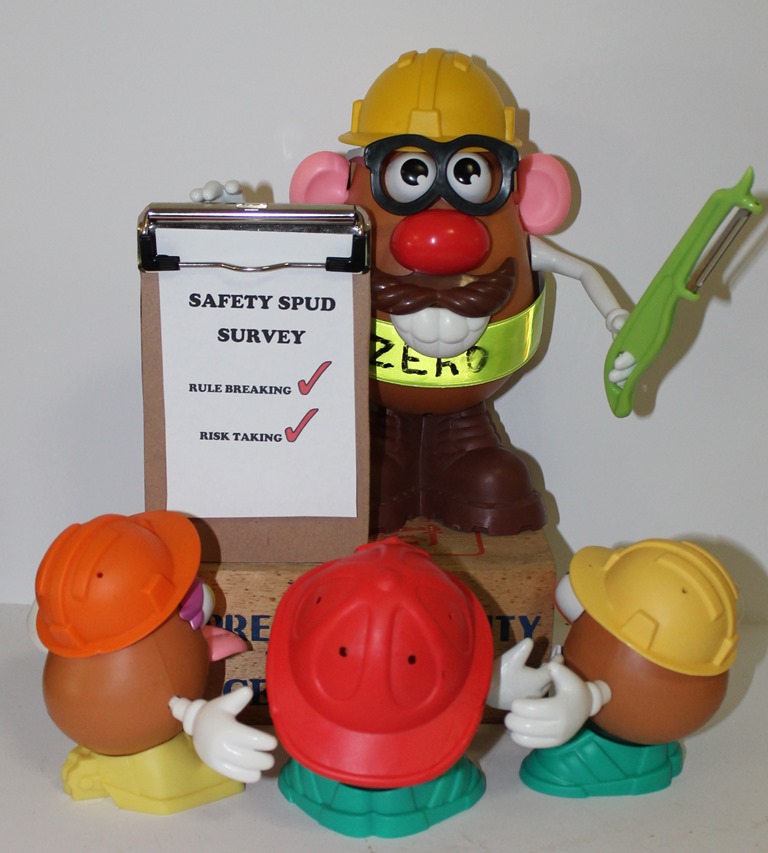
Barry Spud
Latest posts by Barry Spud (see all)
- Barry Spud Discovers Ethics: Unfortunately, It Applies to Him - November 7, 2026
- Kevin Returns from SPoR: Emergency Reinduction Required - November 7, 2026
- Safety Santa Is Coming to Audit - November 7, 2026
- Barry Spud Discovers the Value of Safety - November 7, 2026
- Sadie Tater Sees Red Over Pink - November 4, 2026
Loved this material- you have a “form for that” and I have this article to bring a smile on to my face. Thank you…
The last thing a professional needs is those pesky people getting in the way of objects.